Showing posts with label Salamanca. Show all posts

Friday, August 12, 2011

A Farewell to Spain

"Men go abroad to wonder at the heights of mountains, at the huge waves of the sea, at the long courses of the rivers, at the vast compass of the ocean, at the circular motions of the stars, and they pass by themselves without wondering." - Augustine of Hippo

My time in Spain has come to an end with all the bittersweet feelings that are sure to accompany such a conclusion. A nervous excitement has taken hold of many summer program students in Salamanca. They pack the shops trying to find their last souvenirs and hold study halls in the cafés, attempting to cram in endless conjugations and corresponding verbs before finals.
But the majority of students have adopted the Spanish calm. They sit in the Plaza Mayor enjoying their last ice cream. They stroll through the parks with their hands behind their back and see the summer flowers beginning to fade in anticipation of fall. They sit by the Rio Tormes with a book in their hand and bare feet in the grass. They breathe it all in and know that they have not only discovered another culture, but a new part of themselves in that culture. It seems that we, the consummate tourists, have discovered Fuentes’ Buried Mirror as well.
However, with the end of our travels comes a certain temptation to believe that the Spain we have come to know will be forever frozen in the way we remember it, in the history we relate. Narcissistic in the extreme, this thought is quickly banished as we see the changing leaves and entering novitiates who will no doubt add to the country’s rich history.
Spain and her culture may be rooted in a layered history but she continues to change with her people. The roots of Spain are strong, buried in riots and victories, dictators and kings, expulsions and conquests; but the leaves of Spain, the culture of Spain, continue to evolve and grow.
Spain lives on through its lengthy history, its magnanimous buildings, its inimitable customs, its diverse religions and, most importantly, through its people.

Tuesday, August 9, 2011

Spain and the Church

The towers of Universidad Pontificia
from inside Casa de las Conchas
On the Rua Antigua in Salamanca there are two ancient edifices that face each other at uncomfortably close angles. These buildings are known to all of Salamanca as the Casa de las Conchas and the Universidad Pontificia. The Casa de las Conchas is a solid garrison lavishly decorated with carved sea shells and extravagant flourishes, while the Universidad Pontificia is a towering cathedral and college with illustrious religious images sculpted into the lofty buttresses. Passersby pause in the shadow of the two buildings and tilt their heads in curious gestures, as they ponder why two buildings of such grandeur are built so close as to block the other’s unique architecture.
Legend has it that the Jesuits built the Universidad Pontificia first and the owners of Casa de las Conchas, in an attempt to keep up with the Spanish Joneses, built their seashell house at the doorstep of the magnanimous structure. When the Jesuits saw that the finished Casa de las Conchas blocked their illustrious façade they began to spread a rumor around town that each shell carved into the side of Casa de las Conchas contained a precious jewel. What proceeded were a series of vandalisms against the Casa de las Conchas, resulting in ugly pock marks where certain shells used to be.
Whether this legend proves to be true or false, it serves as a somewhat accurate representation of the relationship between Spain with the Catholic Church.
Since Isabel and Ferdinand reconquered Spain “debajo del cruz” “under the banner of the cross” in 1492, Spain’s history has been forever entwined with that of the Catholic Church. At times, it seems that it is an insurmountable task to dissect a facet that is both a part of the culture and a part of the soul of Spain. At others, it is evident that their relationship is a part of the Spanish culture, but does not encompass the culture.
Depending on the leadership of Spain, there have been times of both war and peace with the Catholic Church. The history between these two factions is too vast to recount; however, fundamentally, a comfortable alliance of give and take had remained the status quo until the 1930’s. Up until the Second Republics radical anticlericalism and Franco’s subsequent despotic adoption of the faith for Spain, the Church had remained an inherent component of the Spanish culture. However, after Franco’s abuse of power, it seems that Spain is wary of religious influence. In fact, the most recent Spanish constitution, written in 1987, emphasizes the separation of church and state in Spain.
Nevertheless, no amount of wishing can take away the traditions and memories of a 500 year relationship. In fact, in less than a week, Madrid will host more than a million Catholic youth and the head of the Catholic Church, Pope Benedict XVI, for the 2011 World Youth Day. An infinite number of Spanish cathedrals are papered with banners promoting the event both inside and outside of Madrid. The presence of Spanish citizens protesting the Pope’s arrival only serves to reinforce the polemic relationship between religion and state.
Like the infamous edifices of Casa de las Conchas and Universidad Pontificia, Spain and the Catholic Church share a relationship that is both celebrated and mourned. There is no moving these buildings, there is no changing history, there is only the fact that they must continue to live side by side, sharing each other’s history and tradition.   


Thursday, July 28, 2011

Spain and the Americas

There is a flipside to every coin, a dark side for every light, and the discovery of the Americas is no exception for Spain. While the discovery is known as a key player in the economic history of Spain, it is also acknowledged as a black mark in her treatment of the conquered. It is acknowledged, but not overly dwelt on. Like most historical events, the discovery of the Americas and the treatment of her peoples is simply an event of the past – it serves as a lesson, and at times leaves a scar.

In my first days of literature classes at the University of Salamanca, someone touched on Latin American writers and asked our professor what she thought of them. Our professor hesitated to say much but commented that, often times, Latin American writers are overly fixated on the maltreatment of the native peoples by the Spanish conquistadors. It seems that for many, the time of bereavement has long since passed, leaving the balm of centuries to assuage any hard feelings.

Perhaps Latin American writers dwell on the travesties of Spain, but many Latin American people look on their Spanish heritage as a status symbol. The feelings of the Latin American students with whom I worked was definitely a favorable one. Those with Spanish heritage were always to be envied and if you were graced with the lisp of Spain, better to exaggerate it than to leave any shadow of doubt as to your heritage. A girl with both a Mexican passport and Spanish passport thanks to the happenstance of birth was to be envied as much as one with both Mexican and American passports thanks to the situation of their birth on the Mexican-American border. One lucky girl enjoyed the prestige of Spanish blood while another enjoyed the ease of United States citizenry.

Like the unfinished La Sagrada Familia in Barcelona, perceptions continue to change and evolve concerning the relationship between Spain and the New World. However, as it stands, it seems that Spain would move past their controversial relationship with the Americas, and Latin America would hold onto the legacy of Spain as a sign of their own worth or of their own misfortune.

Thursday, July 21, 2011

Huerto Calixto y Malibea

I have made mention before of certain well known writers who have planted their roots in Salamanca. Being a city built around its university, it is little wonder that so many famous writers come from this place. On a larger scale the same could be said of the region of Castile & Leon, where Salamanca is located. Several authors, particularly those of the Generations '98 and '27, have come from the Castile & Leon area, including Unamuno, Garcia Lorca, and Azorin.

Perhaps, it’s the environment here that has served to inspire both poet and lover alike. At the southern part of historical Salamanca there is a garden called “Huerto Calixto y Malibea“. It is named after one of the greatest works of Spanish literature, “La Celestina”, and is a public park for any who would like to visit. “La Celestina” is a tragic tale of two lovers, Calixto and Malibea, whose forbidden love caused them to arrange a secret meeting in “El Huerto”.

In the Huerto of Salamanca there is a statue of “La Celestina” standing guard over the garden. The landscaping is beautiful and provides incredible views of the city in the north and the River Tormes in the south. However, the Huerto’s most extraordinary trait is the well at the center of the garden. The arch over the well is covered with locks and below, in the depths of the dark water, lay their corresponding keys. Tradition has it that whenever someone falls in love in the city of Salamanca they attach a lock to the well of the Huerto and throw away the key symbolizing their commitment.

This is yet another example of the deeply rooted tradition in Spain. It is a tradition founded in literature, in poetry, in the deepest parts of the Spanish culture; and, in a symbiotic twist, it is this tradition that serves to inspire another generation of writers.

Monday, July 18, 2011

Franco and Unamuno

Today commemorates the 75th anniversary of the start of the Spanish Civil War. The conflict would last for three years and prove victorious for one Francisco Franco, dictator of Spain from 1936 to 1975. It is difficult to interpret the sentiments of the Spanish people toward the Franco regime. As a foreigner, one must tread the waters of the Franco regime carefully as it is a subject that cuts to the heart of Spain. For some, it was a reality that they lived with for the greater parts of their lives and therefore not easy to express or digest. For most, it is simply a reality of Spain’s personal history and identity.

There is a story concerning Franco and a well known author in Salamanca named Don Miguel de Unamuno. Like the famous Fray Luis de Leon, Unamuno was a rector at the University of Salamanca in addition to being a world renowned writer. His diverse writings spoke to the splendor of Spain and her traditions.

During the Franco regime, government delegates, or Franquistas, visited Salamanca, and Unamuno, as rector, had the responsibility of welcoming the generals. At a meeting with the heads of state, Unamuno began to argue with a Franquista general named Millan-Astray. Unamuno claimed that Millan-Astray was trying to cripple Spain's culture and people.

"You will win, but you will not convince," Unamuno said. "...because to convince means to persuade. And to persuade you need something that you lack: reason and right in the struggle. It seems to me useless to beg you to think of Spain.”

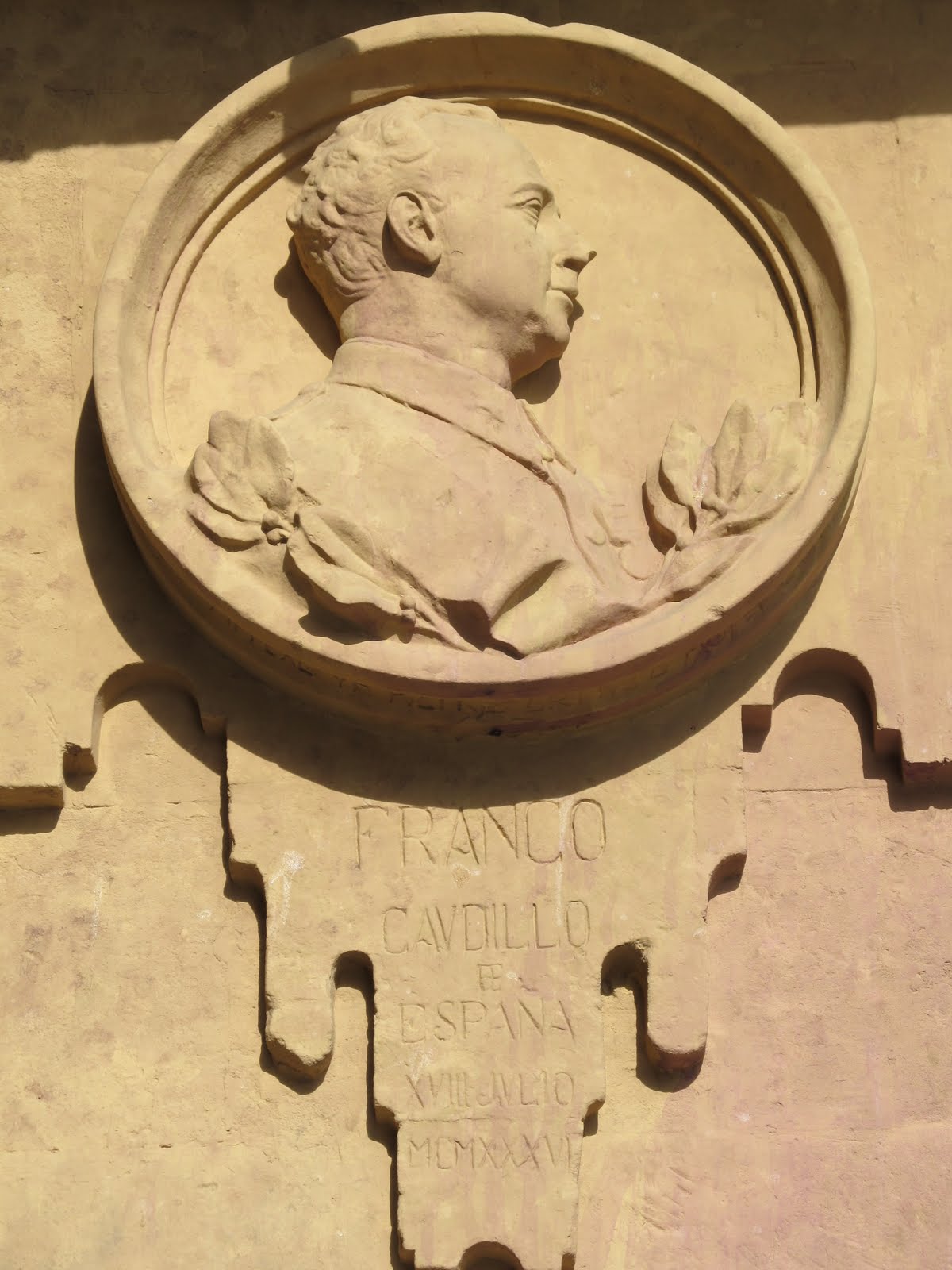
Some time after his meeting with the Franquistas, Unamuno passed away. His coffin was draped with the Franquista flag. As he predicted, Unamuno remaind unconvinced and Franco won, leaving a symbol of his victory with the interred rector. And in the Plaza Mayor in Unamuno's town of Salamanca, Unamuno's likeness stares across at a similar carving of Franco, challenging Spain's dictator even in death.

Sunday, July 10, 2011

Segovia's Treasures

When I used to work with Latin American students, I was constantly impressed by how influenced the students were by American culture. Their constant references to Justin Beiber, High School Musical and all things Disney surprised me, but I soon wrote it off as the large influence of U.S. culture on the world as a whole. While the influence of U.S. culture cannot be dismissed, the city of Segovia proves that not even Disney is solely of American ingenuity.
Segovia is situated about two hours outside of Salamanca and is one of the best representations of Old Castile. One of Segovia’s most famous attributes is the Alcazar. The Alacazar is a behemoth castle on top of a large hill. It is known within Spain for its beauty and its grandeur. It is known throughout the world as the inspiration behind the castles in Disney’s Snow White and Sleeping Beauty. How strange that I boasted of U.S. influences throughout the world, when in fact ours is based on another culture as well.
But the story of Segovia reaches farther back then the Spanish palaces and their consequent movie roles. Segovia also boasts some of the oldest remaining Roman aqueducts in the world. Segovia’s aqueducts are more than 2,000 years old and span across the city façade like ancient guardians, protecting the rich culture of the city. Moorish geometrical designs also cover the sides of buildings, reminding everyone of a forgotten father of Spanish culture.

Thursday, July 7, 2011

The Tunas of the Plaza Mayor

The corrido de toros, or the running of the bulls, no longer graces the Plaza Mayor in Salamanca. Where once there were drunken athletes and rampaging bulls, there are now strolling tourists and hungry diners. Truth be told, the running of the bulls, and bull fighitng in general, has become discouraged throughout the years due to the dangers for both man and beast. However, Salamanca does not allow Pamplona to monopolize all of the San Fermin festivities. The university town still finds a way to celebrate the traditions through their musical Tuna groups.

The Tunas are specific to Salamanca and date back to the XIII century when university students worked their way through school by singing at restaurants. Now, hundreds of years later, the Tunas still perform in the Plaza Mayor in their original costumes. The recording of CDs and the sea of cameras do not hinder the traditional group. Red and yellow bands duel from across the square while crowds gather and clap to the rhythm.

The night of July 7th was no exception. The Tunas were in full swing, singing ballads pertaining to the running of the bulls with their usual bravado and enthusiasm.

Wednesday, July 6, 2011

The 4th of July on Spanish Soil

The 4th of July is not a holiday in Spain, but the people of Salamanca treat it as such. For residents of the city the 4th is a day when the streets become congested with American visitors. Thanks to the 1,500 foreign students that are visiting the city this summer - 70 percent of whom are American students - the 4th of July serves as another way for the people of Spain to celebrate.


Throughout the day of independence, restaurants advertise American specialties like hot dogs or perritos calientes. Toward nightfall the Plaza Mayor becomes crowded with bar owners sporting American flags draped over their shoulders and handing out invitations to their nightclubs with promises of free drinks. American students did not disappoint. Hundreds, American or otherwise, flocked to the celebrations around the city and reveled in the red, white and blue decorations that draped ancient European buildings.


The contrast of a country so young celebrating in a country so ancient was not lost on many. The 4th of July may not be a part of Spanish culture, but in Spain any day to celebrate is a good day indeed.

Monday, July 4, 2011

An Astronaut at Catedral Nueva

With each European city that I visit, I am more amazed by the rich culture that overflows the seems of modern development. But no other city has enchanted me as much as Salamanca. Salamanca is the perfect blend of comfortable tradition and relaxed culture. Known for hosting the oldest university in Spain as well as a bustling campus life, Salamanca serves as a window to the past, but is full of young people. It expresses beautifully the old being enjoyed by the new.


Midnight in the Plaza Mayor hosts hundreds of college kids talking in groups or enjoying tapas and sangria at the bar. But dispersed among the college crowd are old couples strolling hand in hand through the busy square, or small children running ahead of their parents to watch a street performer's skilled ventriloquoy.

One of the most visual representations of this blending of the old and new can be found at the Catedral Nueva in center of the city. Teeming with flying buttresses and intricate carvings, the mammoth Catedral Nueva was built in the 1500s. In the 1900s workers slaved over the restoration of the building and left their own mark in the cathedral's carvings. Toward the front of the Catedral Nueva workers carved a small astronaut into the scroll work of the cathedral's pillars. Workers placed the astronaut on the pillar as a representation of the century that the restoration took place. As a symbol, the astronaut looks wildly out of place among the busts of long-forgotten saints and the crests of Spanish kings. However, it embodies the eternal spirit of past and present in Salamanca.

Wednesday, June 15, 2011

Bienvenidas!

Welcome to "Communicating Culture", a blog dedicated to the culture and history of Spain from the perspective of an outsider.

In two weeks, I will begin my study abroad program in Salamanca, Spain. While taking classes in Spanish language, history and literature at the University of Salamanca, I will also be recording my observations of the culture and history of the country in this blog. My hope with this blog is not so much to give you a blow by blow of each tourist attraction in Spain, but to analyze the culture behind those sites and cultural practices.