Thursday, July 7, 2011

The Tunas of the Plaza Mayor

The corrido de toros, or the running of the bulls, no longer graces the Plaza Mayor in Salamanca. Where once there were drunken athletes and rampaging bulls, there are now strolling tourists and hungry diners. Truth be told, the running of the bulls, and bull fighitng in general, has become discouraged throughout the years due to the dangers for both man and beast. However, Salamanca does not allow Pamplona to monopolize all of the San Fermin festivities. The university town still finds a way to celebrate the traditions through their musical Tuna groups.

The Tunas are specific to Salamanca and date back to the XIII century when university students worked their way through school by singing at restaurants. Now, hundreds of years later, the Tunas still perform in the Plaza Mayor in their original costumes. The recording of CDs and the sea of cameras do not hinder the traditional group. Red and yellow bands duel from across the square while crowds gather and clap to the rhythm.

The night of July 7th was no exception. The Tunas were in full swing, singing ballads pertaining to the running of the bulls with their usual bravado and enthusiasm.

Wednesday, July 6, 2011

San Fermin Commences


Today marked the beginning of the San Fermin running of the bulls throughout Spain. This dangerous tradition takes all of Spain by storm, but perhaps none so much as Pamplona. The "chupinazo" that initiates the running of the bulls was in full swing in Pamplona today and promised a celebration like no other with participants from all over the world. Just as Salamanca helped celebrate the independence of the United States on July 4th, participants from every corner of the globe came to Pamplona for this incredible celebration.

Pamplona's famed running of the bulls is deeply rooted in tradition, but is the most famous in Spain due to the attention that Ernest Hemingway gave in his writings on the celebration. Hemingway brought the world's attention to this particular city's festivities and since then the celebration has become synonymous with the city.


The 4th of July on Spanish Soil

The 4th of July is not a holiday in Spain, but the people of Salamanca treat it as such. For residents of the city the 4th is a day when the streets become congested with American visitors. Thanks to the 1,500 foreign students that are visiting the city this summer - 70 percent of whom are American students - the 4th of July serves as another way for the people of Spain to celebrate.


Throughout the day of independence, restaurants advertise American specialties like hot dogs or perritos calientes. Toward nightfall the Plaza Mayor becomes crowded with bar owners sporting American flags draped over their shoulders and handing out invitations to their nightclubs with promises of free drinks. American students did not disappoint. Hundreds, American or otherwise, flocked to the celebrations around the city and reveled in the red, white and blue decorations that draped ancient European buildings.


The contrast of a country so young celebrating in a country so ancient was not lost on many. The 4th of July may not be a part of Spanish culture, but in Spain any day to celebrate is a good day indeed.

Monday, July 4, 2011

An Astronaut at Catedral Nueva

With each European city that I visit, I am more amazed by the rich culture that overflows the seems of modern development. But no other city has enchanted me as much as Salamanca. Salamanca is the perfect blend of comfortable tradition and relaxed culture. Known for hosting the oldest university in Spain as well as a bustling campus life, Salamanca serves as a window to the past, but is full of young people. It expresses beautifully the old being enjoyed by the new.


Midnight in the Plaza Mayor hosts hundreds of college kids talking in groups or enjoying tapas and sangria at the bar. But dispersed among the college crowd are old couples strolling hand in hand through the busy square, or small children running ahead of their parents to watch a street performer's skilled ventriloquoy.

One of the most visual representations of this blending of the old and new can be found at the Catedral Nueva in center of the city. Teeming with flying buttresses and intricate carvings, the mammoth Catedral Nueva was built in the 1500s. In the 1900s workers slaved over the restoration of the building and left their own mark in the cathedral's carvings. Toward the front of the Catedral Nueva workers carved a small astronaut into the scroll work of the cathedral's pillars. Workers placed the astronaut on the pillar as a representation of the century that the restoration took place. As a symbol, the astronaut looks wildly out of place among the busts of long-forgotten saints and the crests of Spanish kings. However, it embodies the eternal spirit of past and present in Salamanca.

Friday, July 1, 2011

Ghosts of the Madrid Protest

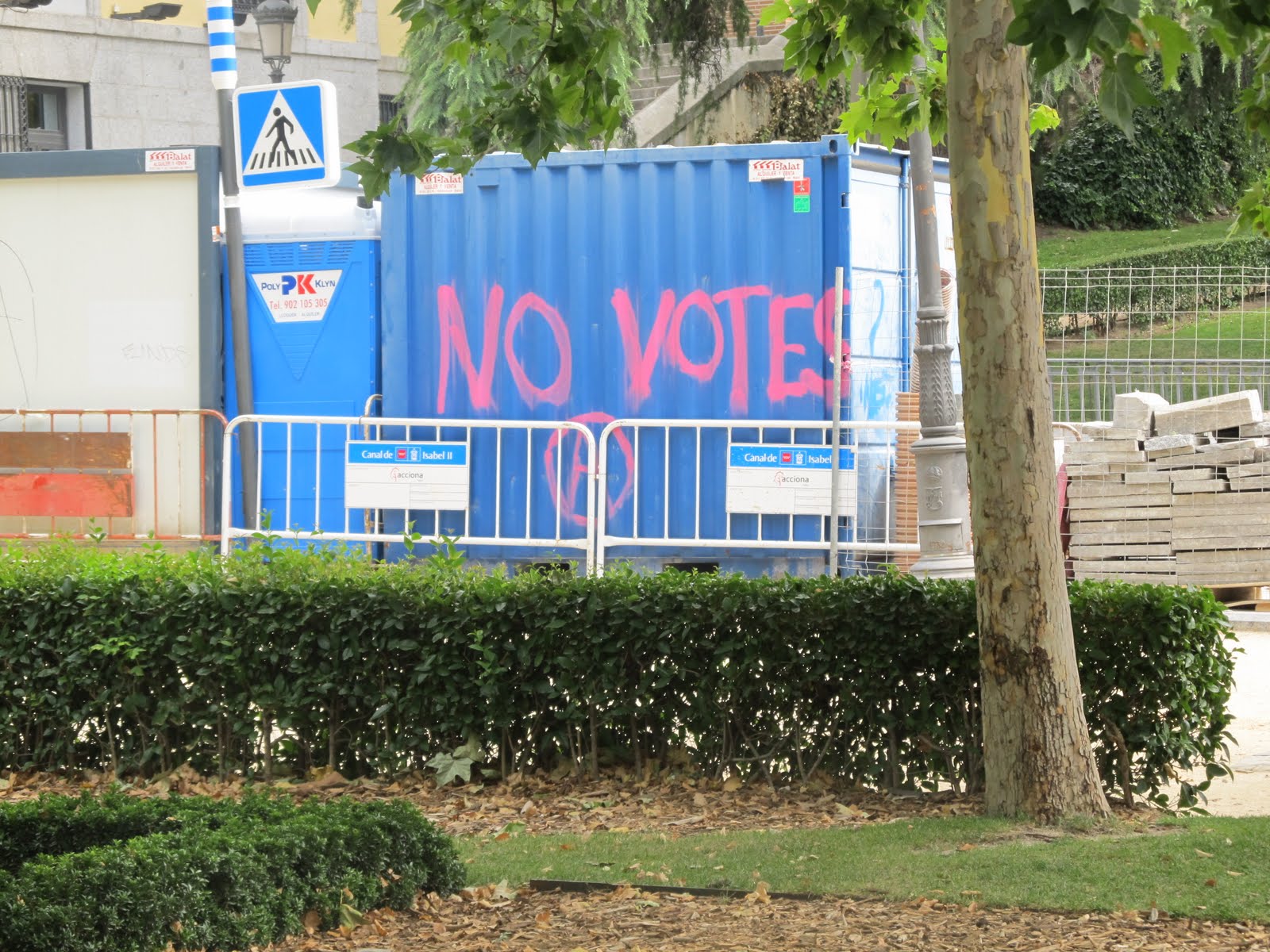
Madrid's plazas are quieter than they used to be. The shouts of protestors and the threat of police barricades are now replaced by the songs of traveling performers or the laughter of amused tourists. But there are still remnants of the protests that rocked the nation to be found in grafitteed messages and forgotten sit-down sites. Grafitti outside of the Palacio Real expresses the frustration of protestors right to "no votes". In Puerto del Sol, a remaining sign promises the end of the citizens' silence.

The protests in Madrid have long since ended but one might ask - as they look at Mickey andMinnie Mouse taking a water break in 90 degree weather - if anything has changed. Have the protests succeeded? Has the 21 percent unemployment rate decreased?


Indeed, little remains of the May protests except the working conditions that they protested. But the historical precedent that was begun in the Tahrir Square of Egypt has entered Spain's history as well. No matter the outcome, the protests in Madrid will shape the history and culture of the Spanish people.