Monday, July 18, 2011

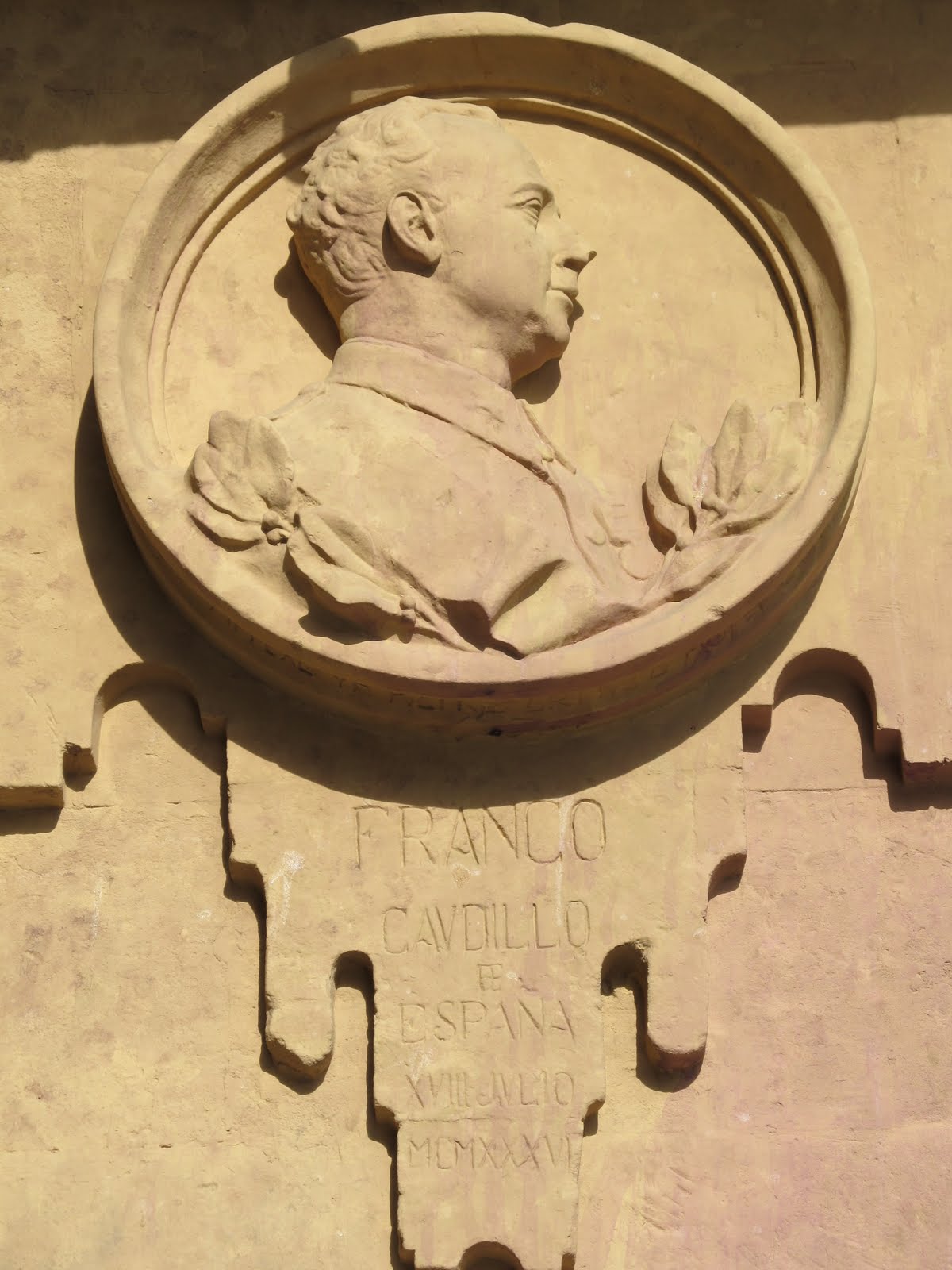
Franco and Unamuno

Today commemorates the 75th anniversary of the start of the Spanish Civil War. The conflict would last for three years and prove victorious for one Francisco Franco, dictator of Spain from 1936 to 1975. It is difficult to interpret the sentiments of the Spanish people toward the Franco regime. As a foreigner, one must tread the waters of the Franco regime carefully as it is a subject that cuts to the heart of Spain. For some, it was a reality that they lived with for the greater parts of their lives and therefore not easy to express or digest. For most, it is simply a reality of Spain’s personal history and identity.

There is a story concerning Franco and a well known author in Salamanca named Don Miguel de Unamuno. Like the famous Fray Luis de Leon, Unamuno was a rector at the University of Salamanca in addition to being a world renowned writer. His diverse writings spoke to the splendor of Spain and her traditions.

During the Franco regime, government delegates, or Franquistas, visited Salamanca, and Unamuno, as rector, had the responsibility of welcoming the generals. At a meeting with the heads of state, Unamuno began to argue with a Franquista general named Millan-Astray. Unamuno claimed that Millan-Astray was trying to cripple Spain's culture and people.

"You will win, but you will not convince," Unamuno said. "...because to convince means to persuade. And to persuade you need something that you lack: reason and right in the struggle. It seems to me useless to beg you to think of Spain.”

Some time after his meeting with the Franquistas, Unamuno passed away. His coffin was draped with the Franquista flag. As he predicted, Unamuno remaind unconvinced and Franco won, leaving a symbol of his victory with the interred rector. And in the Plaza Mayor in Unamuno's town of Salamanca, Unamuno's likeness stares across at a similar carving of Franco, challenging Spain's dictator even in death.

Sunday, July 17, 2011

Siesta Suggested for Germany

Spain is a country where the influences of many different cultures can be seen, including those influences from the Roman, Arab and Jewish civilizations. However, it is rare to see that process of cultural influence and change in practice. But in an article on Yahoo today, readers saw a little of the Spanish influence creep into the culture of Europe. The article spoke of experts in Germany who are recommending siestas or short nap times in places of work throughout the country. Refering to Spain's successful siestas, experts claim that a short break in the work day works to reenergize and motivate employees.

Saturday, July 16, 2011

The Walls of Avila

Medieval giants surround the city of Avila, a small yet veritably fortified city. These giant walls of Avila, constructed over a 9 year period in the 11th century, embrace the hometown of the counter reformation Saint Teresa. What is more impressive than the appearance of these walls however, is the diverse effort that went into their construction. Built over Roman ramparts, the walls of Avila owe their making to many hands. Among those who occupied the city of Avila and helped in the wall’s construction are the Romans, Visigoths, Arabs, Jews and Christians. A plaque on the wall compares the giant structures to a great book in which all styles, cultures, languages, and visions of the world are represented - a mixture of influences much like the greater culture of Spain.

Despite Avila’s overwhelming exterior, her people and streets still subscribe to the familial and comfortable Spanish society. Newly wedded couples stroll through the city square in all their finery, while friends meet for a drink in the shaded terraces.

Indeed, everyone, citizen and tourist alike, are quite comfortable in this historical city. After climbing the walls in the melting sun, our group took shelter under the shade of the giant structures. A group of elderly couples came rambling down the street and began to drop in the shade of the walls. A row of gray heads lay in easy company in the grassy shade. An old man beside me leaned over and said, “Así es como vivimos en España.” “This is how we live in Spain.”

Wednesday, July 13, 2011

Fray Luis and Spanish Timing

There is a well known story in Spain about Fray Luis de Leon, a rector of the University of Salamanca during the XVI century. It is said that during his studies, Fray Luis criticized the Latin translation of the Bible and proceeded to translate the "Song of Solomon" from Latin to Spanish. The powers that be were infuriated with Fray Luis and arrested him while he was teaching a class. He was imprisoned in Valladolid for four years. At the end of those four years, Fray Luis was released from prison and returned to teach classes at the University of Salamanca. Fray Luis began his first class by saying, "Decíamos ayer," or "As we were saying yesterday..."

Fray Luis's famous words are remembered throughout Spain to this day and encompass the Spanish understanding of time. The Spanish concept of time is one of a relaxed disdain for the hour, day or year. Compared to the fast paced culture and rigid schedule of the United States, Spain's hours of work and play are relaxed and flexible. Most stores open no sooner than 9 or 10 in the morning and close for up to 3 hours for the afternoon siesta. Visitors soon discover the benefits of Spain's siesta because, although most shops close around 7 or 8 p.m., the Spanish waking hours often last far into the small hours of the morning.

This is not to say that the Spanish do not keep a schedule. Indeed, foreign students soon learn that Spain's relaxed schedule does not extend to her places of learning. However, Fray Luis's indifference toward the time lost due to his unjust imprisonment is the same as a Spaniard's indifference toward the conventional hours of work and play. Time is not money here; time is a commodity meant to be savored.

Sunday, July 10, 2011

Segovia's Treasures

When I used to work with Latin American students, I was constantly impressed by how influenced the students were by American culture. Their constant references to Justin Beiber, High School Musical and all things Disney surprised me, but I soon wrote it off as the large influence of U.S. culture on the world as a whole. While the influence of U.S. culture cannot be dismissed, the city of Segovia proves that not even Disney is solely of American ingenuity.
Segovia is situated about two hours outside of Salamanca and is one of the best representations of Old Castile. One of Segovia’s most famous attributes is the Alcazar. The Alacazar is a behemoth castle on top of a large hill. It is known within Spain for its beauty and its grandeur. It is known throughout the world as the inspiration behind the castles in Disney’s Snow White and Sleeping Beauty. How strange that I boasted of U.S. influences throughout the world, when in fact ours is based on another culture as well.
But the story of Segovia reaches farther back then the Spanish palaces and their consequent movie roles. Segovia also boasts some of the oldest remaining Roman aqueducts in the world. Segovia’s aqueducts are more than 2,000 years old and span across the city façade like ancient guardians, protecting the rich culture of the city. Moorish geometrical designs also cover the sides of buildings, reminding everyone of a forgotten father of Spanish culture.